
Diamond cutting blades are an essential part of almost all construction and renovation projects. These tools are used for cutting asphalt, natural or artificial stone, concrete, reinforced concrete, porcelain, glass, or ceramics. Although they may look similar in shape, they are certainly not the same. It is crucial to use a diamond blade specifically for its intended purpose. We have prepared an extensive article for you where you will find answers to all your questions.
How to Properly Use a Diamond Cutting Blade
There are many situations where a cutting blade can be used and others where there is a high risk of damaging the tool or the workpiece. We will cover all these scenarios in the following sections.
How to Correctly Cool a Diamond Cutting Blade?
Proper cooling has a significant impact on both the lifespan of the blade and the quality of the cut. It is therefore important to ensure the exact conditions for which the tool was designed.
- When dry cutting, high temperatures are generated in the cut, so the blade must be cooled regularly. This means pulling the tool out of the material during the cut and letting it cool down through rotation. This process should be repeated at regular intervals.
- When wet cutting, ensure an accurate and sufficient supply of water directly onto the diamond segment so that the rotation pulls the water deep into the cut. This ensures proper cooling and flushes away ground material particles.
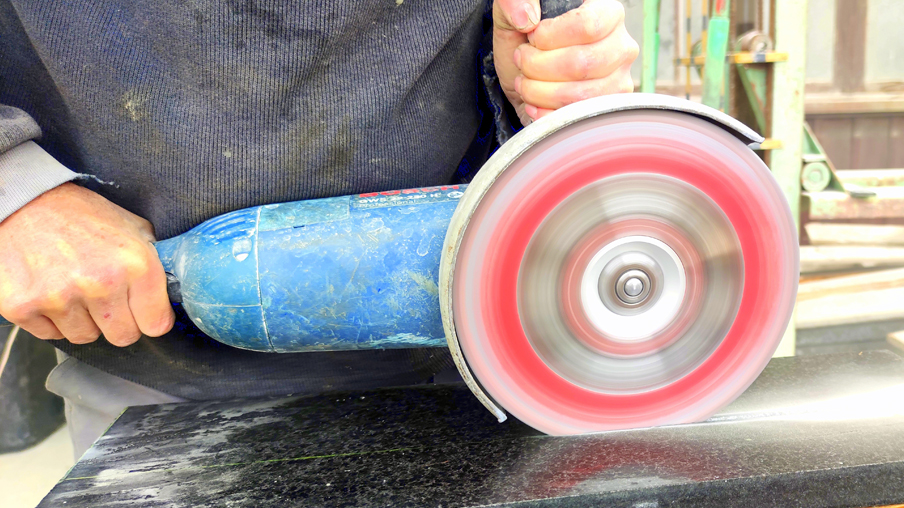
Dry cutting with a large angle grinder and a diamond cutting blade with a 230 mm diameter
Can a Blade Designed for Dry Cutting Be Cooled with Water?
Any diamond segment is sensitive to proper cooling. Therefore, tools designed for dry work can also be cooled with water. This will extend their lifespan and positively affect the quality of work. This applies to all diamond tools, including grinding and polishing tools as well as diamond core bits.
Are You in a Situation Where You Must Use a Blade Dry, Even If It Is Primarily for Wet Work?
There are situations on-site where water cooling is not possible. Yes, you can use a wet-cutting blade without water, but you must pay extreme attention to overheating and cutting speed.
Of course, it depends on the specific composition of the cutting segment. Some segments can handle more demanding use, while others are for less intense conditions. Keep in mind that sometimes it takes very little to ruin the tool. You should also expect that this non-standard situation may affect the cut quality, especially with tiling materials.
What Happens if I Use a Cutting Blade on a Material Other Than the One It Is Intended For?
There are cases where a diamond blade can be used on other materials. However, do not rely on "universal" tools. There is no such thing as a universal diamond blade for all materials that also offers a good lifespan. While you can sometimes use your blade for a different material, be aware it may lead to faster wear or a less clean cut. You must carefully consider whether it is worth the risk of a jagged edge or rapid segment wear.
- A diamond segment for concrete is also suitable for cutting some types of sandstone. It is NOT suitable for stone – there is a risk of overheating and destroying the segment.
- A diamond segment for reinforced concrete is often suitable for cutting granite. In other materials, it risks a slow and messy cut (chipped edges, ruined glaze).
- A diamond segment for marble can work well on ceramics, porcelain, engineered stone, or travertine. In granite, it will have a shorter lifespan but provide a clean cut.
- A diamond segment for ceramics can work well in granite or marble. In concrete or sandstone, it faces rapid wear and low lifespan (even if the cut is clean).

Using a miniature cutting blade on natural stone
The Blade Has Stopped Cutting, the Speed Has Dropped, or the Cut Quality Has Worsened. What Caused This?
Every diamond blade is designed for specific working conditions. Factors include material hardness and abrasiveness, peripheral speed or RPM, and cooling method.
- RPM too high or too low. High RPM with a deep cut prevents optimal cooling, while low RPM doesn't provide enough airflow/heat dissipation, leading to overheating.
- Dulled diamond segment. Some materials reduce the sharpness of the diamond segment. This can be easily fixed, as mentioned later in the article.
- Blade used on the wrong material. The segment may have blackened or overheated, changing its hardness. Signs include sparking or a glowing red segment.
- Ineffective water cooling. We often see water supply that is insufficient or directed only at the blade body. Water must be directed at the teeth/segments so rotation pulls it into the cut.
Visual Damage to the Cutting Blade
- Black segment – likely burnt material residue. Try making several cuts in an abrasive material (firebrick, sandstone, concrete) to clean the segment.
- Cracks – caused by too much pressure on the blade or too fast a feed rate. We recommend NOT USING a tool damaged this way!
- Rainbow colors on the segment – most likely a burnt or hardened segment. It is probably permanently ruined.
- Missing parts – we strongly recommend NOT USING damaged tools!
How to "Sharpen" a Diamond Segment?
Has your diamond blade stopped cutting like it did when it was new? The diamond grit might have become dull due to improper conditions. This happens when the diamond grit becomes flush with the metal bond it is embedded in. In this case, you need to make several cuts in an abrasive material such as sandstone, firebrick, or concrete. Perform this cut dry, without water.
The abrasive material grinds away part of the metal bond, exposing and "sharpening" the diamond grit. The segment is then ready for further work. If the cut quality remains poor even after sharpening, the segment was likely destroyed by unsuitable working conditions.
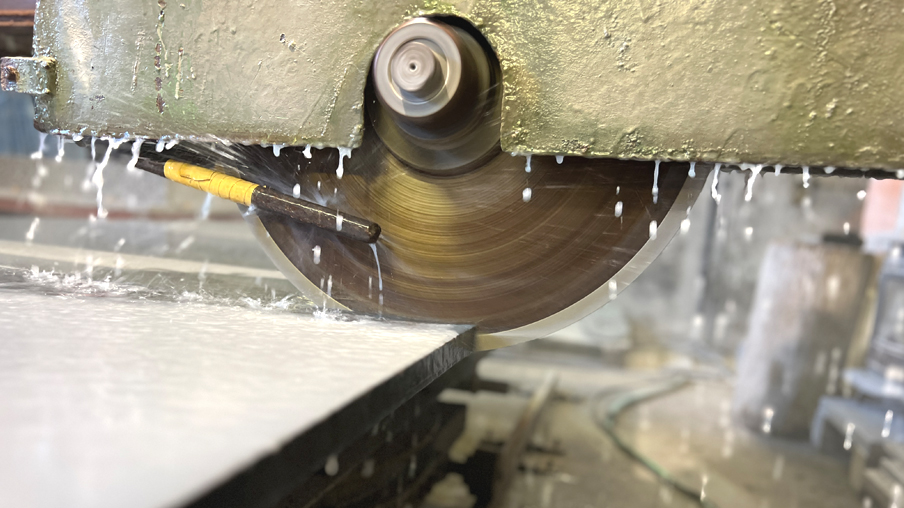
A high-quality cutting blade is the heart of a stonemason's workshop. The difficulty of subsequent steps depends on it.
Common Mistakes When Choosing and Using a Diamond Blade
Correct tool selection and proper use are both vital for quality work. Avoid these frequent mistakes:
- Not following recommended RPM.
- Improper feed speed.
- Incorrect cooling.
- Wrong blade choice for the material.
- Unsuitable work technique. If a tool is meant for straight cuts, it is not safe to use it for shaping or grinding.
Safety Must Always Come First
During my time in this industry, I have seen many situations where serious injury was imminent or, unfortunately, occurred. For example, a small angle grinder usually runs at 11,000 RPM. A detached part from the tool travels so fast it can pierce clothing, windows, or embed itself deep into a wall like a projectile. Do you need more details to realize the gravity of the situation? Several real-world cases were mentioned in the article "Safety First".
Several important points increase safety, such as:
- Visual inspection. Cracks may appear where the segment meets the steel body. Do not use such a tool!
- Tighten and check all screws on the blade flange, or use thread-locking adhesive.
- Observe the recommended maximum RPM.
- Ensure the blade is properly secured in the machine.
- Do not use a larger blade diameter than recommended by the machine manufacturer.
- Ensure proper cooling.
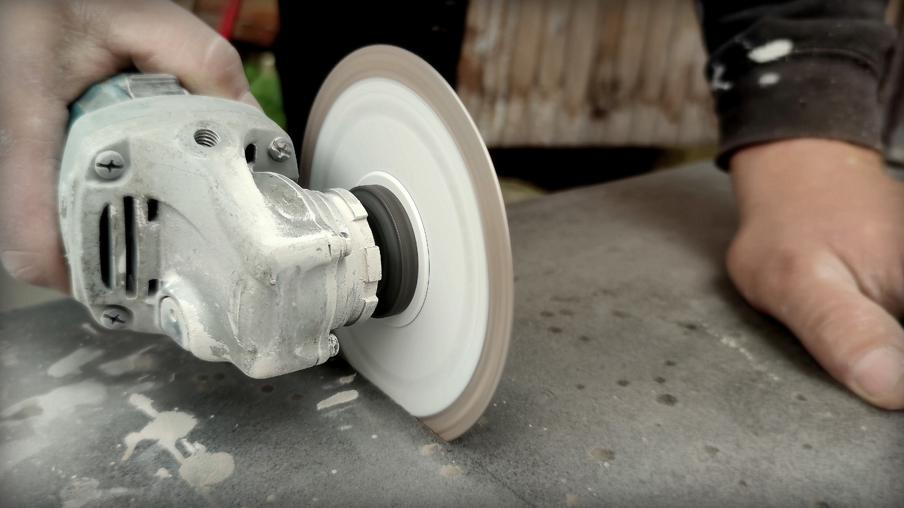
Using a blade without a protective guard. This is a common occurrence and a frequent source of injuries.
Conclusion
Cutting hard materials with diamond blades is the "royal category" of diamond tools. Sometimes you need a lot of information to make the right choice. We always rely on the information and feedback from our experienced clients. Based on these experiences, we try to pass this information on to you as a guide for correct selection. Because high-quality tools are half the success.

Pavol Šáray
CEO & Technical Expert DiaSegment
I spend most of my time in the field with customers, looking for the best solutions for their specific tasks directly at construction sites or in stonemasonry workshops. These field visits are my greatest inspiration – I process practical insights into professional articles to help you navigate the field. Since I am often in full work mode, you might not reach me immediately, but I will be happy to give your questions my full attention.
✉️ E-mail: diamantovenastroje.cz@gmail.com
📞 Mobile: +421 903 528 039
Available on business days 8:00 AM – 4:00 PM.
If I don't answer, please send me an SMS or WhatsApp message, and I will get back to you.