
In the vast majority of cases, radial arm polishers are currently used to regrind old inscription slabs – monuments. This is done when the text on the monument is outdated, poorly placed, or contains an error in the text or date. Well, such things happen.
Is a radial arm polisher mandatory equipment for a stonemason?
Technical parameters or how to polish with a radial arm
A constant water flow of 10-20 liters per minute is recommended. For the tool to function correctly, the water must be fed through the axis directly to the center of the polishing disc and filtered from impurities.
- Grinding – grits #30 to #60 | Higher pressure (2-5 bar) | Lower speed 400-600 rpm
- Polishing – grits #100 to #3000 | Gradually lower pressure with each grit | Higher speed 800-1200 rpm
- Buff - Felt – minimal pressure | Lower speed approx. 700 rpm | minimum water
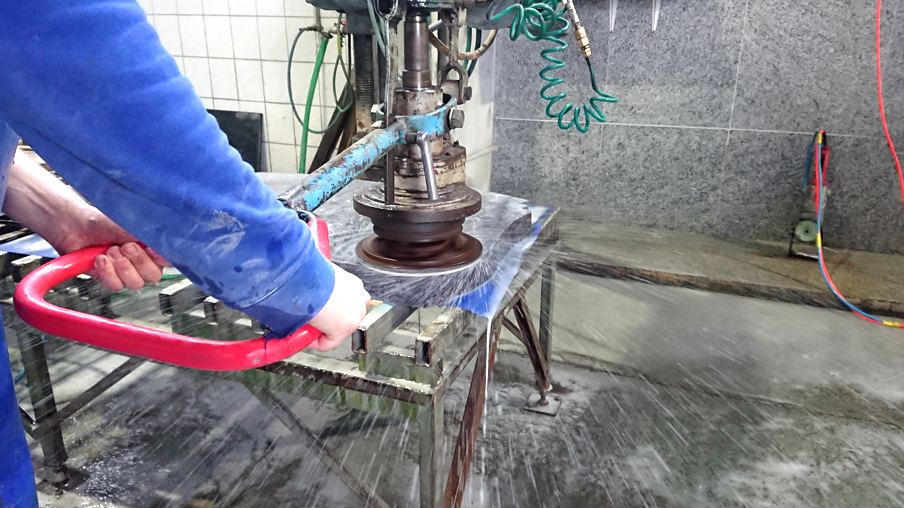
Polishing a monument - inscription slab with a 3-step set
Ways of mounting the backer pad into the machine
Ways of mounting the disc - tool
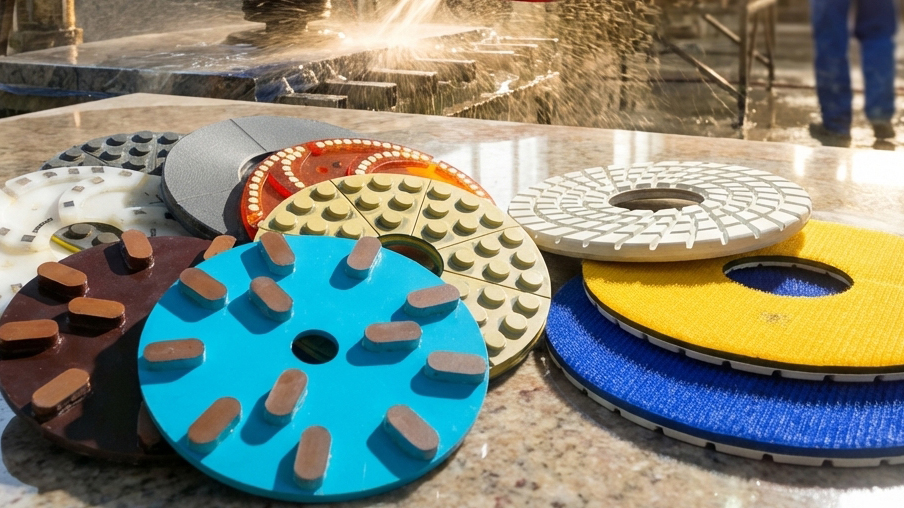
Which set to choose? A brief overview of tools with a diameter of 250 mm.
- Probably the most modern set is the 3-step. It can be said that in recent years it has been the TOP set, which I can highly recommend. In this model line, we also have extremely popular flexible and hard polishing pads for hand tools, which are undoubtedly among our bestsellers.
- The classic set with grits from #30 to #3000 is represented by the eight to nine-step RESIN set. It is a traditional and still preferred set of tools whose grits can be combined with discs from other manufacturers. This way, you can smoothly transition from a competitor's set to a new one as you need the discs. Another difference is that it is not necessary to use the entire set, and thus all grits from the coarsest #30 to the finest #3000.
- Hard discs have a great advantage, resulting in a perfect plane. Polishing discs RESIN-METAL with grits #30, 50, 100, 200, and #400 are very popular. It is not necessary to buy the whole set at once. Individual grits can be skipped or combined with soft discs. The most preferred is the combination of grits #30 and #100, which level the surface, grind out the lettering, and prepare the surface for polishing. Subsequently, you can continue from grit #1 from the 3-step set.
- The BUFF grit is a chapter in itself. Buff is very similar in composition to a felt disc, into which polishing powder is pressed. You can choose from hard or soft - flexible buff.
What diameter of polishing disc to choose?
Classification of discs by hardness and their use
- water stays less on a rounded surface and thus drains better
- light breaks better on a rounded surface, which increases the gloss
- Soft discs with Velcro attachment have a greater tendency to bend at the edges of the polished material and thus grind the very edge more.
- Hard polishing discs maintain a better plane even at the edges.
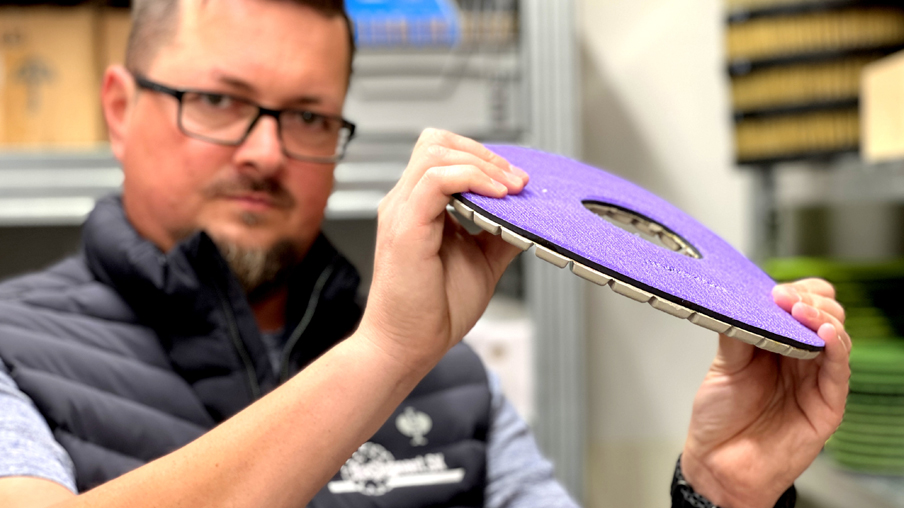
Combinations of different types of discs according to hardness
- If the entire set is soft – i.e., with Velcro attachment, it is of course fine. Polishing discs with Velcro attachment will follow and polish even slight inequalities.
- First discs hard and the rest soft – This combination is, for me, the most optimal and very often preferred. The first grits thoroughly level the surface and prepare it for the following steps – polishing. During the polishing process, smaller and smaller layers are gradually removed, so there is no risk of deforming the surface like with the first (coarse - sharp) grits.
- Soft discs at the beginning and the rest hard is a significant problem. Especially for an inexperienced master who cannot control the leveling. It really takes practice and concentration to avoid stressful situations or embarrassing complaints like: "your discs can't polish the edge of the stone!" Yes, I've dealt with that too. And more than once.
What about safety when working with a radial arm polisher?
Besides the usual safety instructions, I would highlight only one case from practice. It occurred because the master did not secure the stone (monument - inscription slab) on the work table under the radial arm polisher.
I must admit, I probably don't know a master who would secure the stone against movement during this work. This is because when polishing granite (from #30 up to #3000), the disc almost slides over the stone without much resistance. However, when polishing with a buff or felt, high working temperatures are generated between the disc and the stone. This causes friction to increase to such an extent that the processed material may move.
A critical situation arises the moment the material moves during buffing enough to be knocked off the table and hit the wall. The material moved an estimated 150 to 200 centimeters. This is a surprising situation even for experienced masters, but not unrealistic. In this case, it ended only with a financial loss for new material and shaping the monument. One shouldn't forget the wall repair and new cladding. It's probably clear to everyone what would have happened if the heavy stone had moved in the opposite direction.
Conclusion
Pavol Šáray
CEO & Technical Expert DiaSegment
Most of my time is spent in the field with customers, where we look for the best solutions for their specific tasks directly at construction sites or in stonemasonry workshops. These field visits are my greatest inspiration – I subsequently process insights from practice into professional articles to help you navigate the subject. Since I am often in full work mode, you might not reach me immediately, but I will be happy to devote my full attention to your questions.
✉️ E-mail: diamantovenastroje.cz@gmail.com
📞 Mobile: +421 903 528 039
Available on working days 8:00 – 16:00.
If I don't answer, please write me an SMS or WhatsApp, and I will get back to you.