
Even the most experienced craftsman has those days when they think, "I should have just stayed in bed!" There is so much that can go wrong in a workshop. A machine breaks, material is ruined, or a cut goes wide. Without a doubt, the worst-case scenario is when an injury occurs.
During my career, I’ve heard many stories that really get under your skin. I’ve prepared a few short stories for you where the situations are real, but the names have been changed for privacy.
A Painful Thumb Injury During Grinding
In the stonemasonry industry, working with an angle grinder is a daily task, especially when a craftsman is shaping stone or creating sculptures and monuments. During this work, the protective blade guard often simply gets in the way and restricts the movement of the tool. Unfortunately, that’s the reality—most craftsmen remove the guard for this reason. That is exactly what happened in this case.
You might expect that the sculptor was hit by a broken piece of the tool. Not in this case. The sculptor mounted the grinding disc and began shaping. He held the small angle grinder with both hands, not realizing that the grinding disc featured a dual M14 and SL mounting system. A single protrusion from the SL mount caught his index finger and crushed the nail. A safety guard would have prevented any contact with this sharp part.
While listening to this story, I learned something interesting. The sculptor poured fresh stone dust from the grinding process into the wound. He claimed it’s "pure nature," has anti-inflammatory effects, and stops bleeding—information he supposedly got from his professor.
Well, I’m not sure I’d have the courage for that. How about you? Have you ever heard of this?
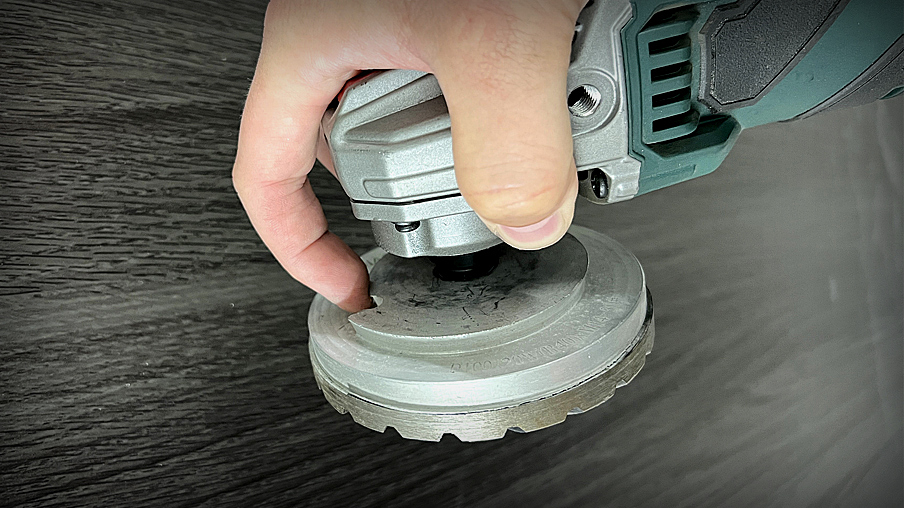
Using a safety guard would have prevented contact between the finger and the SL-mount protrusion on the disc.
The Diamond Projectile
The master craftsman was alone in the workshop. He was actually glad because he could work undisturbed and finish the order. He mounted the grinding cup into the angle grinder and got to work. Everything was going smoothly until the moment too many things happened at once for him to realize what was going on. A loud bang, vibrations from the tool in his hands, pain, and a heavy flow of blood.
The initial shock was replaced by the realization that the situation was grave. The grinding disc, which was only at about half its lifespan, shattered while working with the small angle grinder. The tool, spinning at 11,000 RPM, broke loose and, like a projectile reflecting off the wall, struck the craftsman in the temporal artery.
I’ve heard a similar story that ended in tragedy because help didn't arrive in time. Fortunately, that wasn't the case here.
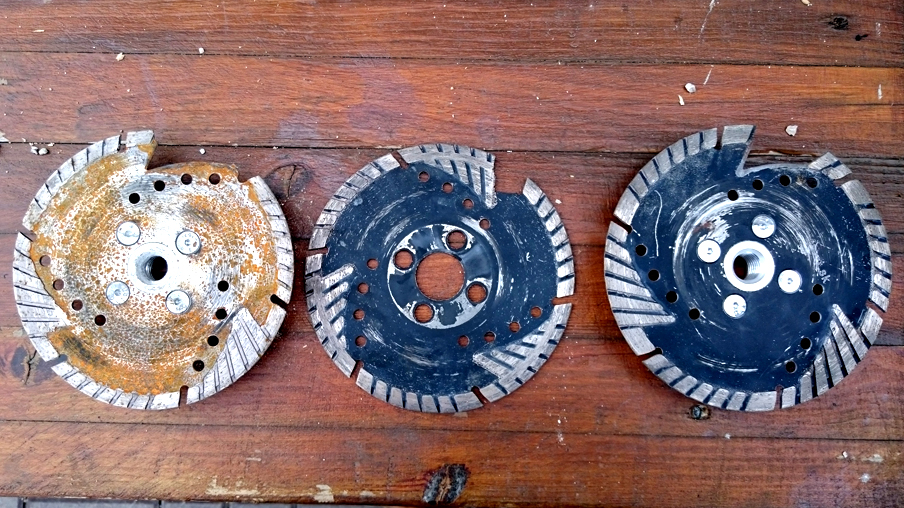
A mass manufacturing defect shows up as identical damage across multiple tools.
When Discs Fly Through the Air
The foreman and his crew were preparing for a job. The stone was cut to size, the edges were polished, and it was time to load the truck and head to the installation. One last check and... "We forgot to polish one edge. I’m not taking it back to the stationary polisher; we’ll just hit it with the dry grinder. Just come over here and hold this for me."
The foreman mounted the polishing pad onto the backer pad, turned on the grinder, and started polishing. After a few seconds, the polishing pad flew off the old backer pad and hit the colleague holding the stone right in the face.
The tool narrowly missed his eye and cut through his eyebrow. A trip to the ER was necessary to get stitches.
Whitey and the Scars on His Face
A short story about a very skilled craftsman who wasn't afraid to handle a large angle grinder to shape stone.
That day, he planned to shape a headstone. He put on a large hoodie, safety glasses, grabbed the angle grinder with a 230mm cutting disc, and started working. However, during the process, the long drawstrings from his hoodie got caught in the disc and were wound into the machine in a split second. The craftsman didn't even have time to react before the cutting disc sliced into his face.
Since that day, a long scar on his cheek and nose serves as a permanent reminder.
It Happened to Us Too, Unfortunately
The date for the international stonemasonry fair in Poznań was approaching. An invitation for a business meeting with a new manufacturer of diamond cutting tools appeared in our inbox. We accepted, the meeting took place, and as tool distributors, we received test samples. There were 20 pieces of very nice-looking cutting discs (125mm diameter) with an interesting segment design.
As with any new product, we gave these samples to stonemasons across Slovakia and the Czech Republic for testing. It didn't take long before the first reports and phone calls started coming in: "A tooth flew off and just barely missed me!" Similar reports kept coming, and we quickly realized it was likely a defective batch. We decided to pull them from circulation immediately. It was likely only due to our quick reaction and huge luck that no one was injured.
We want to believe the supplier was unaware of the issue and did not knowingly put people at risk. Every tool showed an identical defect: a faulty brazed joint between the core of the disc and the cutting segment. Most likely, it was a poorly calibrated machine in production—a mass manufacturing defect